Garage Floor Coatings
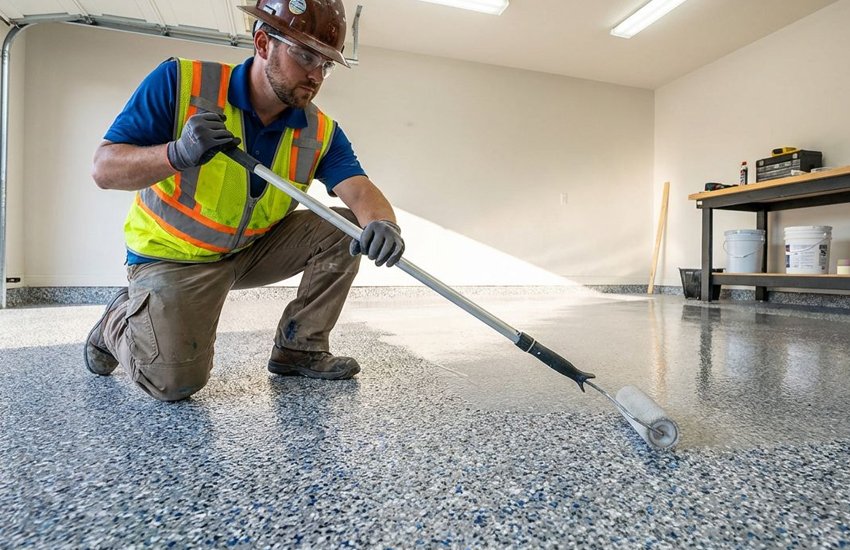
Full-flake polyaspartic garage floors: installed in a day, ready for cars in 24-48 hours.
About Garage Floor Coatings →
If it is concrete, we can coat it: prepared right, tested first, installed in as little as a day.
| Surface preparation | Diamond grinding to CSP 2-3 with HEPA dust extraction |
|---|---|
| Moisture testing | Calcium chloride (ASTM F1869) or in-situ RH (ASTM F2170) |
| Typical garage system | Moisture-tolerant primer, full vinyl flake broadcast, polyaspartic topcoat |
| Return to service | Foot traffic next morning; vehicles 24-48 hours (system-dependent) |
| Installation season | Year-round for interior floors |
Mechanical diamond grinding on every job: never acid etching
Moisture testing before quoting, with mitigation primers where readings demand them
Commercial-grade polyaspartic, epoxy, and urethane systems in flake, quartz, and solid color
Concrete repair, resurfacing, and full replacement in-house when the slab needs more than a coating
Written scope and product data for every system we install
Full-flake polyaspartic garage floors: installed in a day, ready for cars in 24-48 hours.
About Garage Floor Coatings →
Turn a dusty basement slab into finished, moisture-resistant living or storage space.
About Basement & Interior Floor Coatings →
Shops, showrooms, kitchens, and warehouse floors coated on your schedule, nights and weekends included.
About Commercial Floor Coatings →
Protect patios, steps, and aprons from salt and freeze-thaw with breathable exterior systems.
About Exterior Concrete Coatings & Sealing →epoxy primers and high-build commercial systems
polyaspartic topcoats and urethane systems
moisture mitigation and substrate repair
decorative vinyl flake and quartz broadcast media
It depends on square footage, the repair the slab needs, and the system installed, a moisture-mitigation primer or heavy repair changes the number. Every quote is a written, itemized estimate after we see and test the floor, and the estimate is free.
Both, where each belongs: epoxy and moisture-tolerant primers at the slab, polyaspartic at the surface for UV stability, hot-tire resistance, and fast cure. Polyaspartics are themselves a fast-curing type of aliphatic polyurea, so when a company advertises a "polyurea floor," it is the same chemistry family we install as a topcoat. Single-product floors are a marketing simplification; layered systems last.
Usually. Grinding and repair handle most wear, and resurfacing overlays can rebuild a badly scaled surface before coating. When a slab is structurally failed, we say so and quote the replacement instead; we do that work too.
Typical polyaspartic systems take foot traffic the next morning and vehicles in 24-48 hours; commercial urethanes vary by build. Exact times come in writing with the installation.
Texture is a choice, not an accident. Flake and quartz broadcasts add grip, and topcoats take anti-slip additives; we match the texture to how the space is used, from smooth showroom to wash-down kitchen.
Page reviewed and updated by Landscapes Unlimited.
Free on-site estimates across the SE Twin Cities Metro Area. Licensed & insured.
651-216-2883